
YUKI KATAYAMA: REFUSING TO GIVE UP ON HERSELF
Some performances feel less like acting and more like lived experience. In FUJIKO, Yuki Katayama embodies a woman pushed to the margins of society yet determined to carve her own path forward. Set against the backdrop of post-war Japan, the film follows a single mother navigating poverty, loss, and social judgment without ever surrendering her sense of self. The result is a story that has resonated far beyond Japan, earning emotional responses from audiences across Europe and Asia.
For Katayama, the connection to FUJIKO runs deeper than circumstance. While she has never shared her character’s life as a mother, she recognizes the same stubborn independence that led her to leave home, move to Tokyo alone, and pursue acting with little more than conviction to guide her. That refusal to see herself as a victim became the emotional bridge between actress and character.
In this conversation, Katayama reflects on the personal experiences that shaped her performance, the film’s unexpected international appeal, the importance of rhythm and physicality in her craft, and the belief that continues to drive her career today. From surviving uncertainty in Tokyo to starting English lessons from scratch after international festival success, her story mirrors the spirit at the heart of FUJIKO: the determination to keep moving forward, no matter how impossible the road may seem.
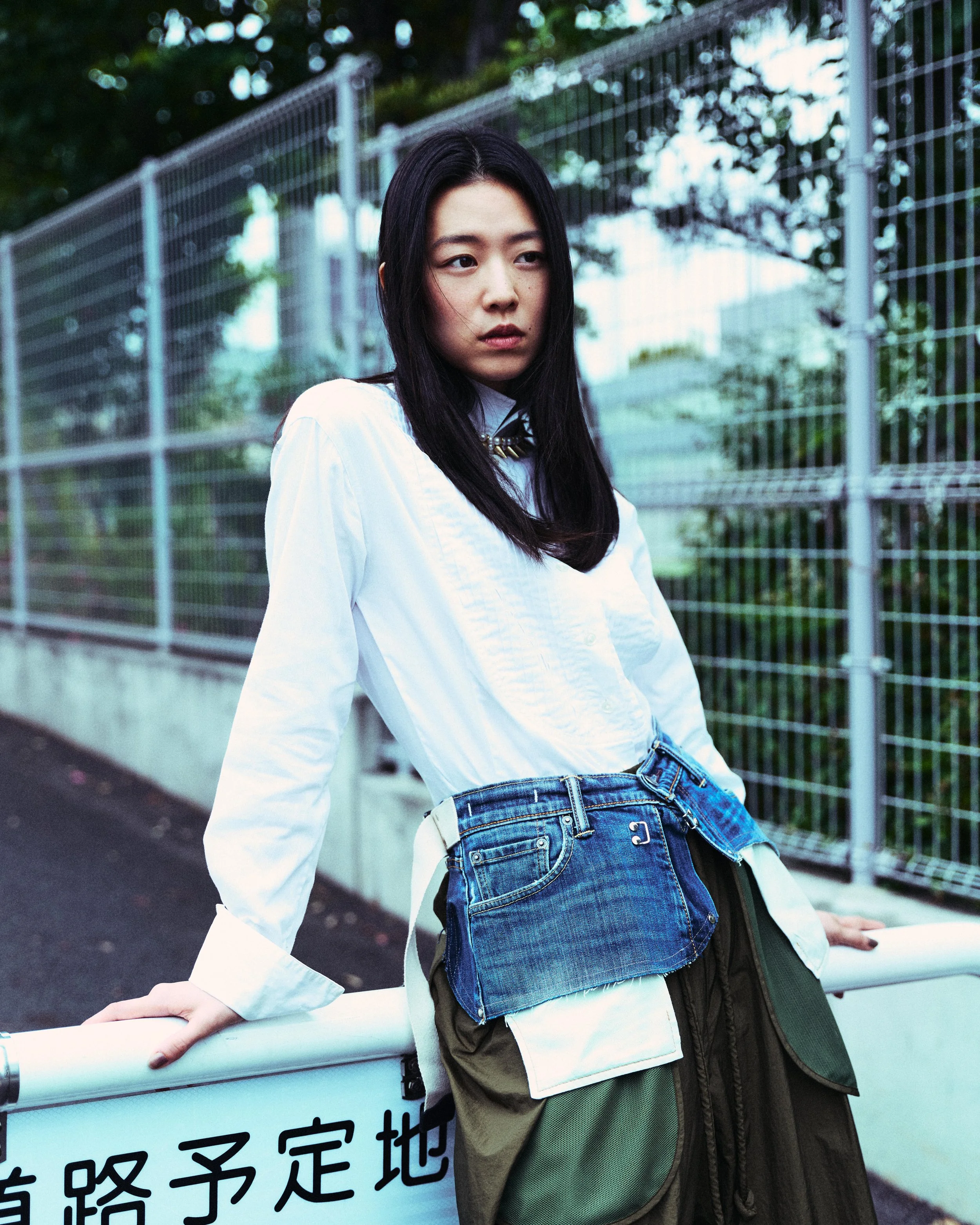
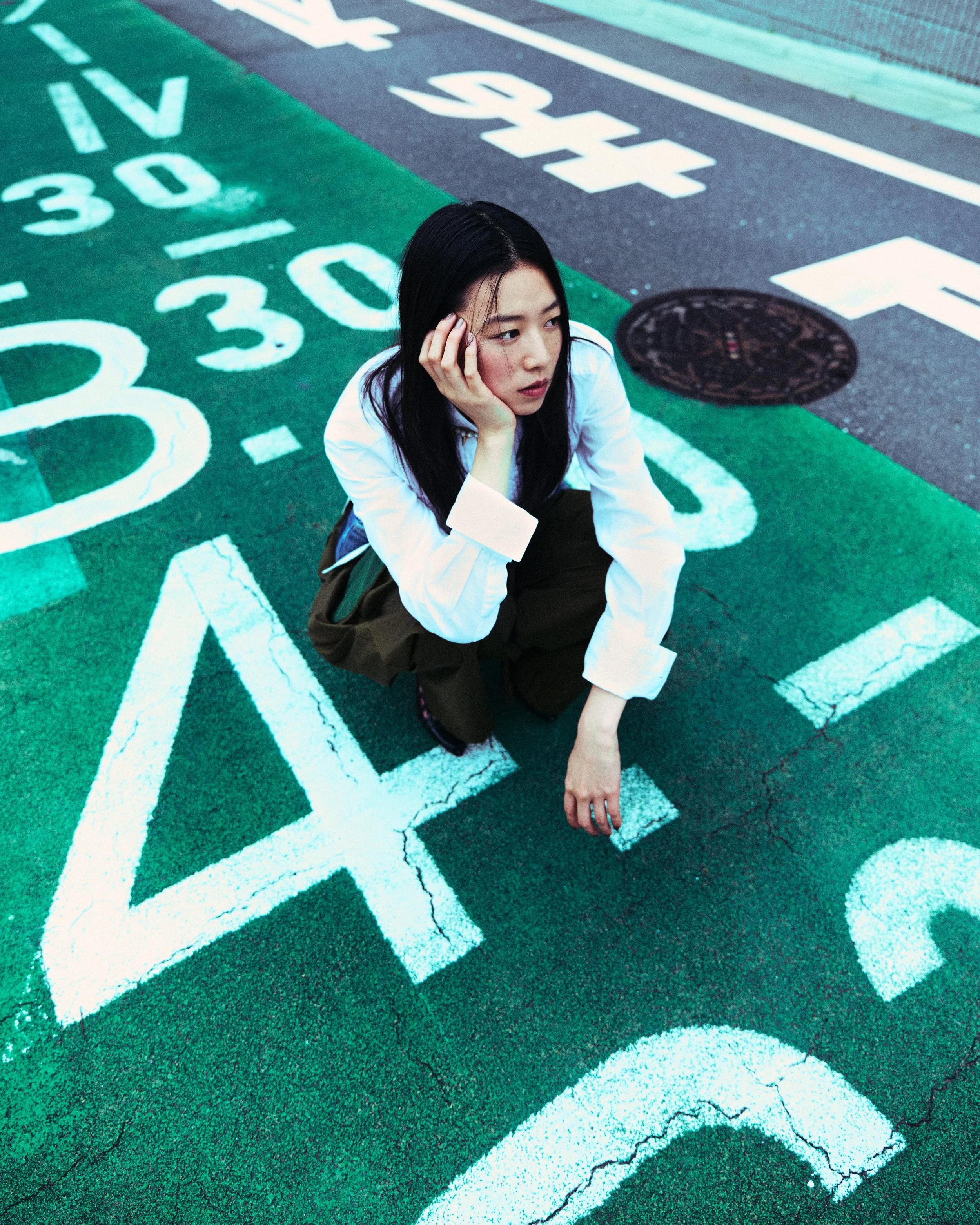
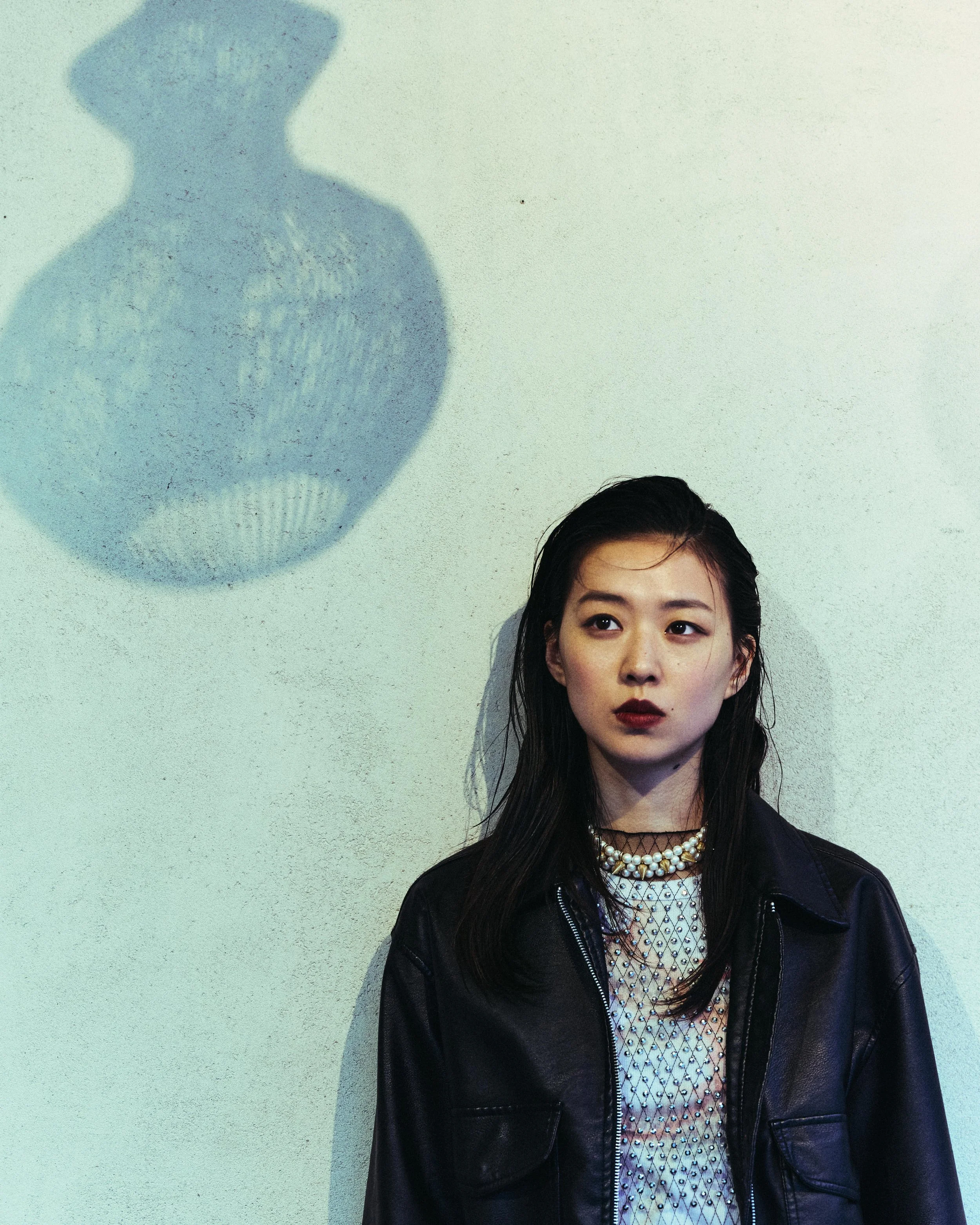
Pants BASE CALM, belt GOODNEWSINTHEMORNING

FUJIKO faces an irrational reality, yet continues to choose her own future through sheer determination. While portraying her, what aspect resonated with you the most, and where did you feel the clearest boundary between yourself and the character?
The biggest difference is that FUJIKO is a single mother. I’m not married and I don’t have children, so our circumstances are fundamentally different.
However, from the moment I was cast until the script was finalized, I received revised versions of the screenplay continuously for about eight months. Because of that, rather than consciously creating the character, I gradually came to understand every aspect of FUJIKO. Scenes were removed, new ones were added, and through that process I felt like I naturally got to know her completely.
Personality-wise, though, I think we’re quite similar. We both have that attitude of, “I’m going to make this happen.” I also left my hometown and moved to Tokyo to pursue my dreams, so I relate to that determination. In fact, I think that similarity is probably one of the reasons I was chosen for the role.
You joined a theater company at 14 and moved to Tokyo at 20, carving your own path from a young age. Were there moments when your own life choices overlapped with FUJIKO’s journey?
When I read the script, it reminded me of when I first moved to Tokyo at 20. I had no money, no work, and no friends there. But somehow, I made it this far. Because of that, I don’t look back on my past with regret or self-pity.
Reading FUJIKO’s story brought those memories back. She loses custody of her child, struggles financially, and faces the hardships of being a single mother, yet she never becomes a tragic heroine. That feeling resonated deeply with me because I feel the same way about my own life.
When I mentioned this to the director during our interview, he told me that was exactly the kind of person he had been looking for—someone who doesn’t fall into pessimism.

The film carries a strong message about female independence. In your own life, is there a belief or dream that you refuse to give up on?
I think it’s simply my desire to become an actress.
When I was in elementary school, around fifth or sixth grade, I went through that phase where everyone wants to be on television. I started thinking about all the possible jobs: announcer, singer, idol, TV personality, actress.
I wasn’t good at studying, so announcer was out. I couldn’t sing, so singer and idol disappeared too. I didn’t think I could make clever comments on TV, so TV personality was crossed off the list. Actress was the only thing left. So I said, “Okay, then I’ll become an actress.” And I’ve followed my own will all the way to where I am now.
The film was highly praised overseas, even by audiences unfamiliar with Japan’s Showa era or the social stigma surrounding single mothers. Why do you think it resonated so strongly?
I think some things simply don’t change. Whether in Japan, Italy, or elsewhere, attitudes toward single mothers may have been similar in the past.
And in Italy, mothers are incredibly strong figures, aren’t they? FUJIKO’s mother is also very strong. Because of that, FUJIKO’s mother became surprisingly popular with Italian audiences. People laughed a lot during her scenes.
There’s a person who lived in Italy for ten years who told me that the film felt very Italian because it portrays the struggles of everyday life in a realistic way. The characters are fighting so hard to survive that it becomes funny at times. That blend of hardship and humor apparently feels very much like Italian cinema.
The screening in Udine was part of an Asian film festival, so we also had viewers from places like Singapore and Vietnam. Many people were crying.
One Singaporean actress told me that when she said she wanted to become an actress, her father strongly opposed it. But she pursued her dream anyway. She said FUJIKO’s experience of being told to live a “proper” life mirrored her own, and that was why she became emotional.
The film’s avant-garde music, dynamic camerawork, vocal rhythm, and physical movements create a tremendous sense of momentum. Was that energy something you consciously planned while acting?
Yuki: During filming, I was very conscious of rhythm.
Scenes like the gambling sequences or the moments when I quickly bite into food were all choreographed according to timing. For example, I would place a tray on the table, grab a sandwich, and take a bite at a precise rhythm.
Those moments were built around the music, so honestly, that wasn’t really my acting—it was entirely the director’s vision.
The animated opening sequence wasn’t originally part of the film. The director thought it might be interesting because Japanese animation is so beloved worldwide, so he decided to include it.
Many of the humorous moments that work internationally were also the result of the director’s perspective, having lived in the UK for twenty years and understanding how foreign audiences perceive things.
Editor:
Most films use music as background accompaniment, but in FUJIKO, the music feels almost like a lead character. It enters scenes the way a DJ mixes tracks. Combined with your vocal rhythm, range, and delivery, as well as your physical presence and long limbs, it creates an incredible sense of movement throughout the film.
Yuki:
As for the music, the director is a huge fan of Oasis and has listened to them for years. Apparently he also worked as a DJ. He’s someone who really lived and enjoyed life, and I think that contributes a lot.
Regarding my voice, a director once criticized me by saying, “Why does every voice you use come from the same place?” It wasn’t a compliment.
People naturally use different voices depending on the situation—talking to someone sitting across from you in a café, whispering, or calling out to someone far away. That comment made me think deeply about voice as a tool.
For the childbirth scene, the shot before it ended on a close-up of me, and the childbirth scene was filmed with exactly the same framing, angle, and head position. The idea was that the audience would suddenly cut from one scene to the next and realize they were in a delivery room before the camera pulled back.
I thought the filming approach was so interesting that I decided to perform it with 120 percent intensity in my voice.

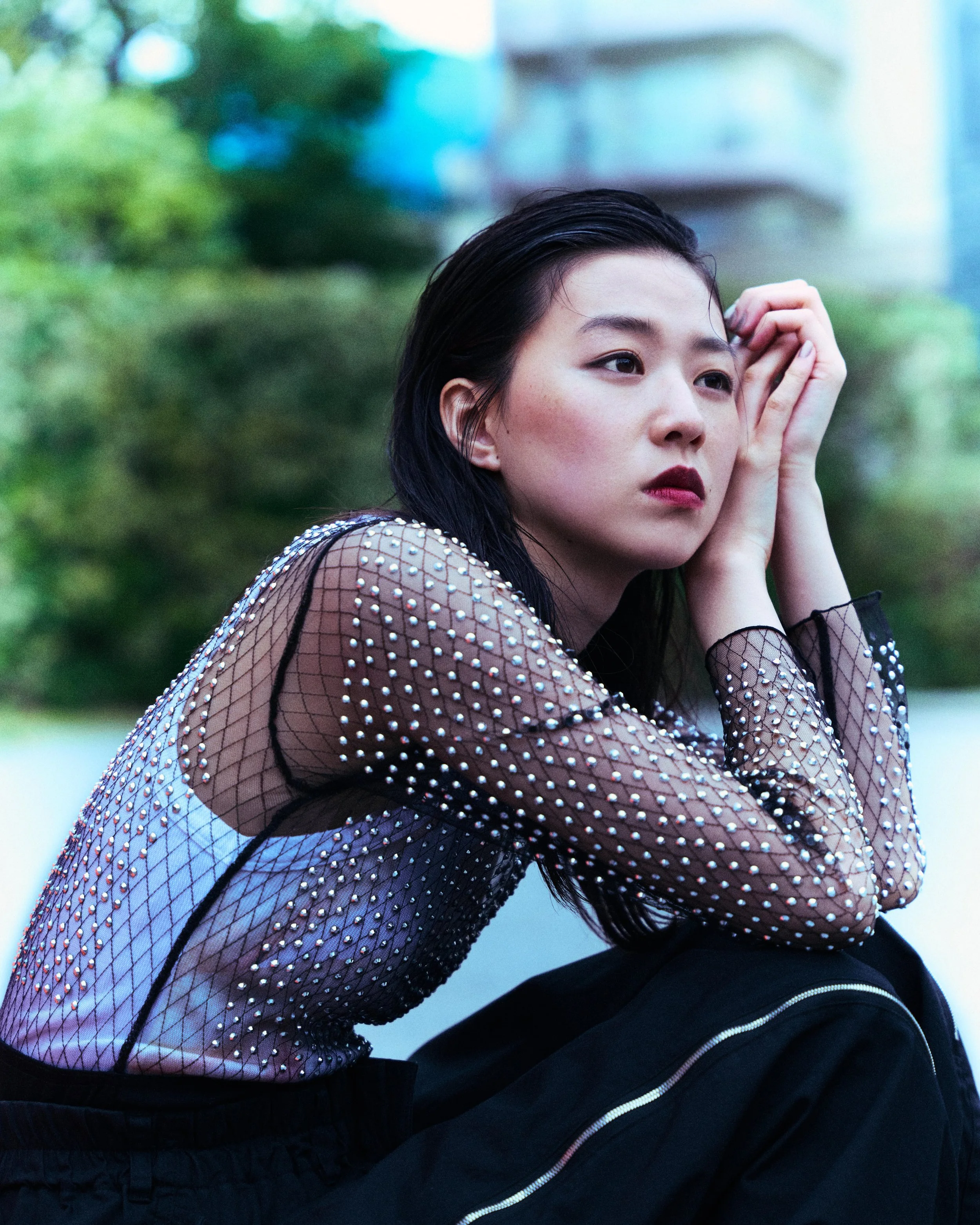
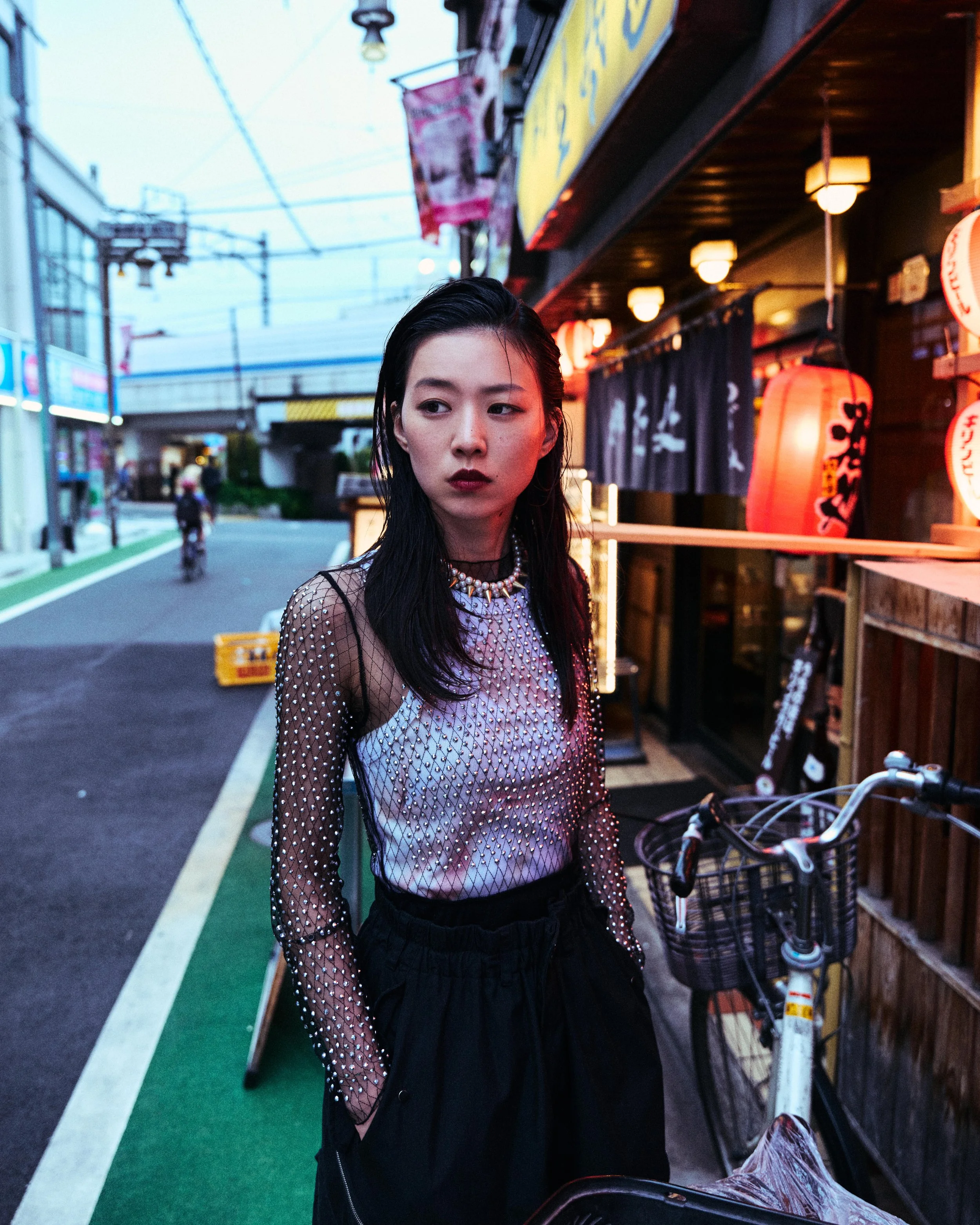
Tank top CARNE BOLLENTE, pants ROTOL
How do you relate to the Showa era depicted in the film?
Nowadays, you can look up anything instantly, so the era didn’t feel that distant to me.
When I was in my early twenties, I loved vintage clothing and wore it all the time. In fact, I think many young people today romanticize the Showa period. There were no smartphones or social media, which must have been inconvenient, but people often imagine it as a more exciting and vibrant time.
One reason FUJIKO’s world felt so convincing was the costume and production design. Everything looked stylish and authentic.
In many Japanese dramas, the protagonist wears different clothes in every scene. But in reality, people repeat outfits. FUJIKO wears the same jeans repeatedly, which felt very realistic. That realism made it easier for me to immerse myself in her world.
What aspects of human nature remain unchanged despite changing times?
Eating. At the most basic level, people eat to gain energy and survive. Food is also a major theme in FUJIKO. Eating, feeding someone else, cooking for someone—those are things that connect people.
When the film screened in Italy, I wondered whether audiences would be bothered by the way people slurp spaghetti, but it was fine.
In Japan, we’re taught not to speak with food in our mouths and to follow proper table manners. Because of that, many actors become overly polite in eating scenes. If you watch carefully, many actors barely eat at all. I’ve always disliked that because it feels unnatural.
I try to actually eat during scenes. There’s a moment when actress Kayoko Kishimoto talks about how shrimp repeatedly shed their shells while eating enthusiastically. Watching a senior actor perform like that made me think, “Exactly. People talk while eating.”
That’s why I genuinely ate a lot during my scenes with Lily and throughout the film.
Who do you most want this film to reach?
The producer, MEGUMI, wanted to make a film about women who actively shape their own lives because she felt that many women in Japan struggle with self-esteem.
The director also wanted to tell the story of his mother. Although the film focuses on women, it’s not a film that criticizes men. Throughout the story, FUJIKO receives help from both men and women.
So I wouldn’t say, “This is a film only for women”. If there’s a target audience, it’s everyone.
When did you first gain confidence that you could make a living as an actress?
Honestly, I’ve never had a moment where I thought, “I can definitely do this.”
But the film Akaneiro ni Yakareru changed me. Until then, acting often felt like memorizing lines, showing up on set, saying them, hearing “cut,” and moving on. I wondered if that was really enough.
Then I was cast as Kei, a sex worker in Akaneiro ni Yakareru. For the first time, I felt afraid. I wasn’t sure I could do it. Even though the director was welcoming me with open arms, I struggled to step into the role. I remember crying on the train ride home. In the film, Kei eventually takes her own life. Even after filming ended, one of her lines stayed with me: “I don’t know why I’m alive.” The truth was, I didn’t know either. That line terrified me.
But after the film was released, more and more people told me it was good. Gradually, I began to accept myself. Then one day, a magnitude-5 earthquake hit Tokyo.
It was the first major earthquake I experienced alone. I was terrified. I remember thinking, “I absolutely do not want to die.”
At that moment, I decided that I wanted to make films for the rest of my life and truly commit to being an actress. That was in 2021.
Ironically, after making that decision, I went three years without receiving any film offers.
Looking back, I think those three years were extremely important. If everything had happened smoothly and I had immediately gotten all the work I wanted, I don’t think I would have been able to give as much of myself to FUJIKO.

As you move toward the next stage of your career, what does the word “ZERO” mean to you?
I actually started studying English from zero just one week ago.
When I was in Udine, a woman handling international sales for FUJIKO told me, “Your acting doesn’t feel uniquely Japanese. You should study English.”
I tend to take advice seriously, so the day I returned from Italy, I signed up for lessons. I started studying a week ago, and honestly, I’m struggling and almost crying over it.
But two years ago, I started learning Korean. Recently I looked back at my very first Korean notebook, and my handwriting was terrible. I could barely understand what I had written.
That made me realize something. You study because you want to learn, and because you don’t know something yet.
Learning Korean and English from zero is difficult precisely because I can’t do them yet. I started Korean from nothing, and now I can speak a little. As a result, I’ve begun receiving more work in Korea.
So I hope that by studying English as well, I’ll be able to collaborate with even more creative artists from around the world—just like the international team involved in today’s photoshoot.
That’s what “ZERO” means to me: the willingness to start again from the beginning in order to reach somewhere new.
Editor: Miho Imai
Photographs: Allan Abani
Hair & makeup: Natsuki Watanabe
Stylist: SHOWROOM501 / DELTA
Production: BLACK PEARL